November 14, 2026 · 7-min read
Public-Domain Christmas Hymns: Six Favorites and the Stories Behind Them
Six well-loved carols, who wrote them, when, and the part of the Christmas story each one tells.
Six of the best-loved public-domain Christmas hymns are "Joy to the World," "Hark! The Herald Angels Sing," "O Come, All Ye Faithful," "It Came Upon the Midnight Clear," "O Little Town of Bethlehem" and "Silent Night." Their words and tunes date from the 1700s and 1800s, so they are free to sing, copy and print, and each one is built on a part of the Christmas story in Scripture. Here is who wrote each, when, and what it sings from.
If you are looking for hymns of waiting for the weeks before Christmas, start with our list of the best public-domain hymns for Advent. These are the songs for Christmas Eve and the twelve days after, when the waiting is over.
What is the story behind "Joy to the World"?
Isaac Watts published it in 1719, in a book of psalm paraphrases. Watts took Psalm 98 ("Sing unto the Lord a new song") and rewrote it in the light of the coming of Christ. That is why it speaks of the earth receiving her King and of nature joining in the singing, rather than telling the manger scene. The tune most people sing today is an arrangement by the American Lowell Mason, built from melodies attributed to Handel.
Read with it: Psalm 98.
Ask: Where does Watts say the whole creation joins the praise, and what does that tell us about the size of Christmas?
What is the story behind "Hark! The Herald Angels Sing"?
Charles Wesley wrote the words in 1739 and published them as a "Hymn for Christmas-Day." The opening you know was not his: the first lines were changed by George Whitefield in 1753. The tune came later still. Felix Mendelssohn wrote the music in 1840 for a different occasion, and William Hayman Cummings fitted it to Wesley's words in 1855.
Read with it: Luke 2:8-14.
Ask: The hymn packs the gospel into short lines. Which line would you teach a child first?
What is the story behind "O Come, All Ye Faithful"?
The hymn began in Latin as Adeste Fideles. It appears in a 1751 collection by John Francis Wade, and hymnals commonly credit him, though his authorship is not proven. Frederick Oakeley made the English translation in 1841, and the version sung today adds verses translated later by William Thomas Brooke, published in the 1880s. Its refrain is an invitation, and it is the shepherds' hymn: come and see.
Read with it: Luke 2:15-20.
Ask: The shepherds went "with haste." What is one thing you would drop what you were doing to see?
What is the story behind "It Came Upon the Midnight Clear"?
Edmund Sears, an American minister, wrote the words in 1849, and they were first published in The Christian Register in Boston in late December that year. Richard Storrs Willis composed the tune, called "Carol," in 1850. The hymn pictures the angels' song of peace and asks what it means for a world that already has plenty of noise.
Read with it: Isaiah 9:6-7.
Ask: The hymn is about peace. Where in your own week would you most like to hear that song?
What is the story behind "O Little Town of Bethlehem"?
Phillips Brooks, an Episcopal priest, wrote the words in 1868, after visiting Bethlehem in 1865. His organist, Lewis Redner, composed the tune "St. Louis" that same year, in a hurry, for the church's Christmas Sunday school service. The hymn takes the quiet of a small town and sets it beside a very large claim: that the hopes and fears of all the years meet there.
Read with it: Micah 5:2 and Matthew 2:1-6.
Ask: Why do you think God chose a small town and a quiet night?
What is the story behind "Silent Night"?
Joseph Mohr, an Austrian priest, wrote the words as a poem in 1816. Franz Xaver Gruber composed the melody in 1818, and the song was first performed on Christmas Eve 1818 at the church in Oberndorf, Austria. The English words most families sing come from John Freeman Young's translation of 1859. Because it is so gentle and so short, it is often the first hymn children learn by heart.
Read with it: Luke 2:1-7.
Ask: What would it have been like to be in the stable that night?
How can we sing these together?
You do not need a choir or a hymnal. A simple rhythm is enough.
- Choose one hymn for each stretch of days. Sing the same one every evening until it is familiar.
- Read the passage first. One short reading from the list above, then the hymn, makes the words mean more.
- Tell one fact before you sing. A single sentence about the author or the year is plenty for children.
- Keep it short. Five minutes at the table beats a long evening that never happens.
- Pause on one line. Ask what it means, and let the answer be small.
If you have not led a hymn at home before, how to lead a hymn study at home walks through the small steps. For hymns to keep all year, try five public-domain hymns every family should know.
Is there a study that goes deeper?
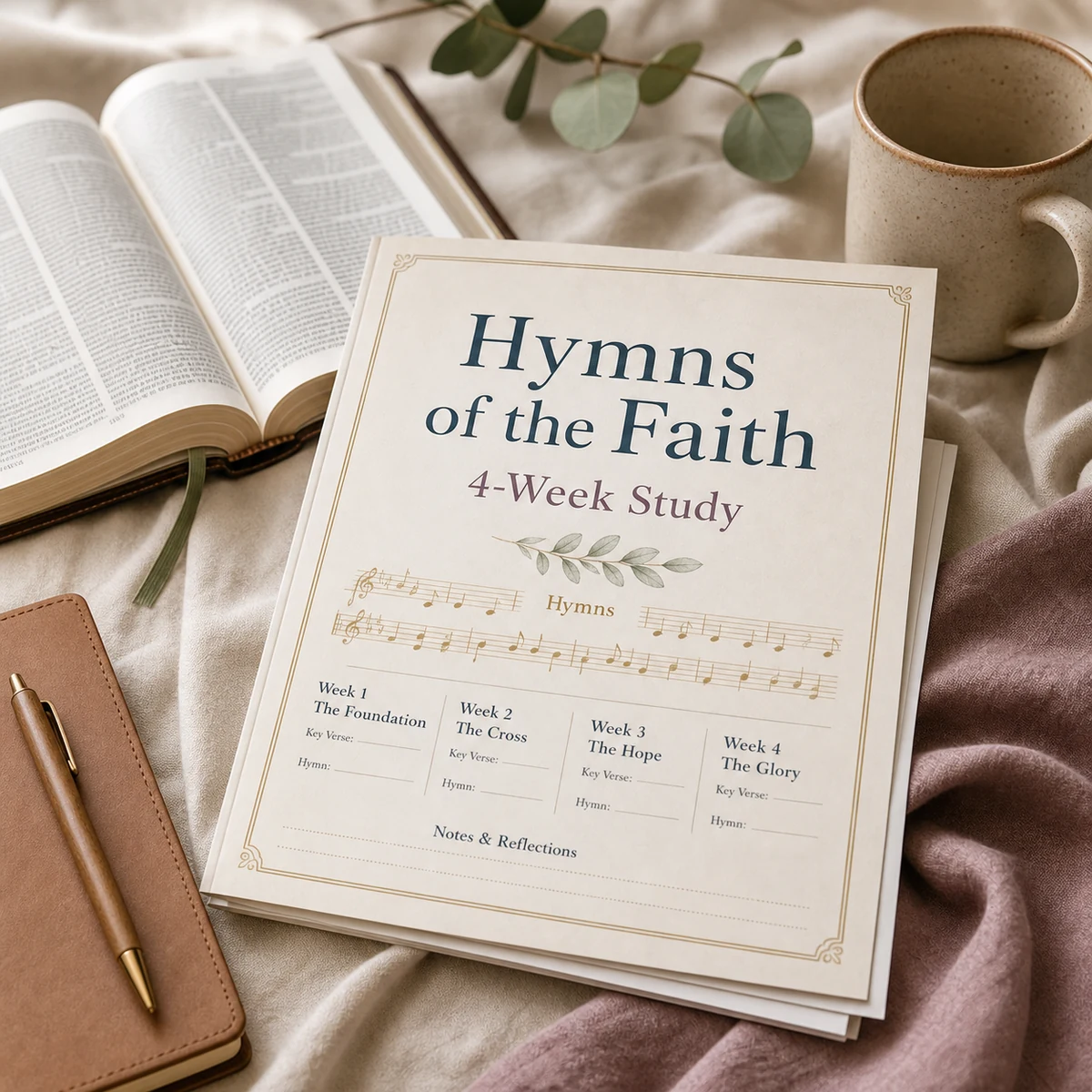
If you would like the history and the Scripture for each hymn gathered in one place, Hymns of the Faith pairs beloved hymns with the Bible passages and stories behind them. You can also browse the Quiet Light Keepers shop for other seasonal studies.
These songs have been sung for two hundred years or more because they tell the story plainly and let it be wonderful. Sing one this week, read its passage, and let the old words do their work.
A printable to help
Frequently asked questions
- What are the best public-domain Christmas hymns?
- Six that are free to sing, print and study are "Joy to the World" (Isaac Watts, 1719), "Hark! The Herald Angels Sing" (Charles Wesley, 1739), "O Come, All Ye Faithful" (Latin, 18th century), "It Came Upon the Midnight Clear" (Edmund Sears, 1849), "O Little Town of Bethlehem" (Phillips Brooks, 1868) and "Silent Night" (Joseph Mohr and Franz Gruber, 1816 and 1818).
- What is the difference between an Advent hymn and a Christmas hymn?
- Advent hymns look ahead and wait for Christ's coming, and belong to the four weeks before Christmas. Christmas hymns celebrate the birth itself and are sung from Christmas Eve through the twelve days that follow.
- Are Christmas hymns really free to copy and print?
- The words and tunes of these six were published in the 1700s and 1800s, so they are public domain and free to sing, copy and print. A modern arrangement or recording can still be protected, so check the specific version before you reproduce it.
- Who wrote "Silent Night"?
- Joseph Mohr, an Austrian priest, wrote the words as a poem in 1816, and the schoolteacher and organist Franz Xaver Gruber composed the melody in 1818. It was first performed on Christmas Eve 1818 in Oberndorf. The usual English translation is by John Freeman Young, 1859.
- How many Christmas hymns should a family learn?
- One at a time is plenty. Sing the same hymn through a week, read the Bible passage beside it, and add the next one when the first feels familiar.
- christmas hymns
- christmas carols
- public domain
- hymn history
- seasonal
- worship
Related reading
- The Story Behind 'Come, Thou Long Expected Jesus'The story behind Come, Thou Long Expected Jesus: Charles Wesley's Advent prayer, the Scripture behind its words and the two tunes it is sung to.
- Advent Bible Study for Women's Groups: Questions for Four WeeksAn Advent Bible study for women's groups: four weeks of passages and discussion questions on hope, peace, joy and love, with tips for leading in a busy December.
- The Story Behind 'O Come, O Come, Emmanuel'The story behind O Come, O Come, Emmanuel: seven ancient Advent prayers, a Latin hymn and Neale's English words. Here is its history and what each verse means.