November 11, 2026 · 5-min read
The Story Behind 'O Come, O Come, Emmanuel'
Seven short prayers, one for each evening before Christmas Eve, became the hymn the church sings when it wants to wait well.
The story behind "O Come, O Come, Emmanuel" begins with seven short prayers that the church sang on the seven evenings before Christmas Eve. Each prayer greets Christ with a name from the prophets, and the hymn gathers those names into one song of waiting. The English words most of us sing come from the Anglican priest John Mason Neale, who translated them in the 1850s.
Where do the words come from?
The hymn grows out of the O Antiphons. An antiphon is a short verse sung before and after a psalm or canticle, and these seven were sung at evening prayer from December 17 to 23, around Mary's song, the Magnificat. They are far older than the hymn itself, and every one opens with the same cry: "O."
The Latin hymn that gathers them, "Veni, veni, Emmanuel," appears in print in a collection of Latin hymns published in Cologne in 1710. From there it travelled slowly, until a nineteenth-century English scholar noticed it.
What are the seven names, and where are they in Scripture?
Each title points back to a promise in the Bible:
- O Wisdom — the Spirit of wisdom promised in Isaiah 11:2, and the Wisdom who speaks in Proverbs 8.
- O Lord (Adonai) — the God who appeared in the burning bush (Exodus 3) and gave the law at Sinai (Exodus 19–20).
- O Root of Jesse — the shoot from David's family tree in Isaiah 11:1 and 11:10.
- O Key of David — the One who opens and no one shuts, from Isaiah 22:22 and Revelation 3:7.
- O Dayspring — the dawn from on high of Luke 1:78–79, the light for those who sit in darkness.
- O King of the Nations — the "desire of all nations" of Haggai 2:7.
- O Emmanuel — "God with us," promised in Isaiah 7:14 and named in Matthew 1:23.
Most hymnals print five or six of these as verses. Each one asks Christ to come, and each one answers its own longing with the same refrain: "Rejoice! Rejoice! Emmanuel shall come to thee, O Israel."
Why do the antiphons spell "ero cras"?
Take the first letters of the Latin titles and read them from last to first: Emmanuel, Rex, Oriens, Clavis, Radix, Adonai, Sapientia. They spell ero cras, Latin for "tomorrow I will be there."
It is a fitting message for the last week of Advent. On the final evening the church sings "O Emmanuel," and the answer to seven evenings of asking is already written into the order of the prayers.
How did Neale bring it into English?
John Mason Neale (1818–1866) was an Anglican priest and scholar who spent much of his life translating ancient Latin and Greek hymns so that English congregations could sing them. He also gave us "Good King Wenceslas." His translation of this hymn appeared in 1851, and the familiar wording, "O come, O come, Emmanuel," spread after it was included in Hymns Ancient and Modern in 1861.
The melody is a plainchant tune arranged by Thomas Helmore, who published it in the early 1850s. It has a quiet, unhurried shape, and it is the reason the hymn feels like waiting even before you reach the words.
Why does a hymn of longing end with "Rejoice"?
Because Advent holds both at once. The verses ask, and the refrain answers. The church sings "O come" because Christ has not yet come in glory, and it sings "Rejoice" because He has already come once and has promised to come again.
That is why this is the hymn to sing when you want children to feel the weight of the season. It lets the waiting be real without letting it become sad.
Singing it this Advent
You can use the seven titles as a countdown to Christmas. Starting on December 17, read one name each evening with its Scripture from the list above, light a candle, and sing the refrain together. By December 23 you will have walked through every promise in the hymn, and Christmas Eve arrives with the whole story already in your hands.
For more hymns to sing across the season, with the story behind each, see The Best Public-Domain Hymns for Advent, which also comes with a free printable Advent Hymn Reading Plan for the four weeks of Advent. If you are new to singing at home, our guide to leading a hymn study at home walks through small, doable steps.
Studying a hymn slowly
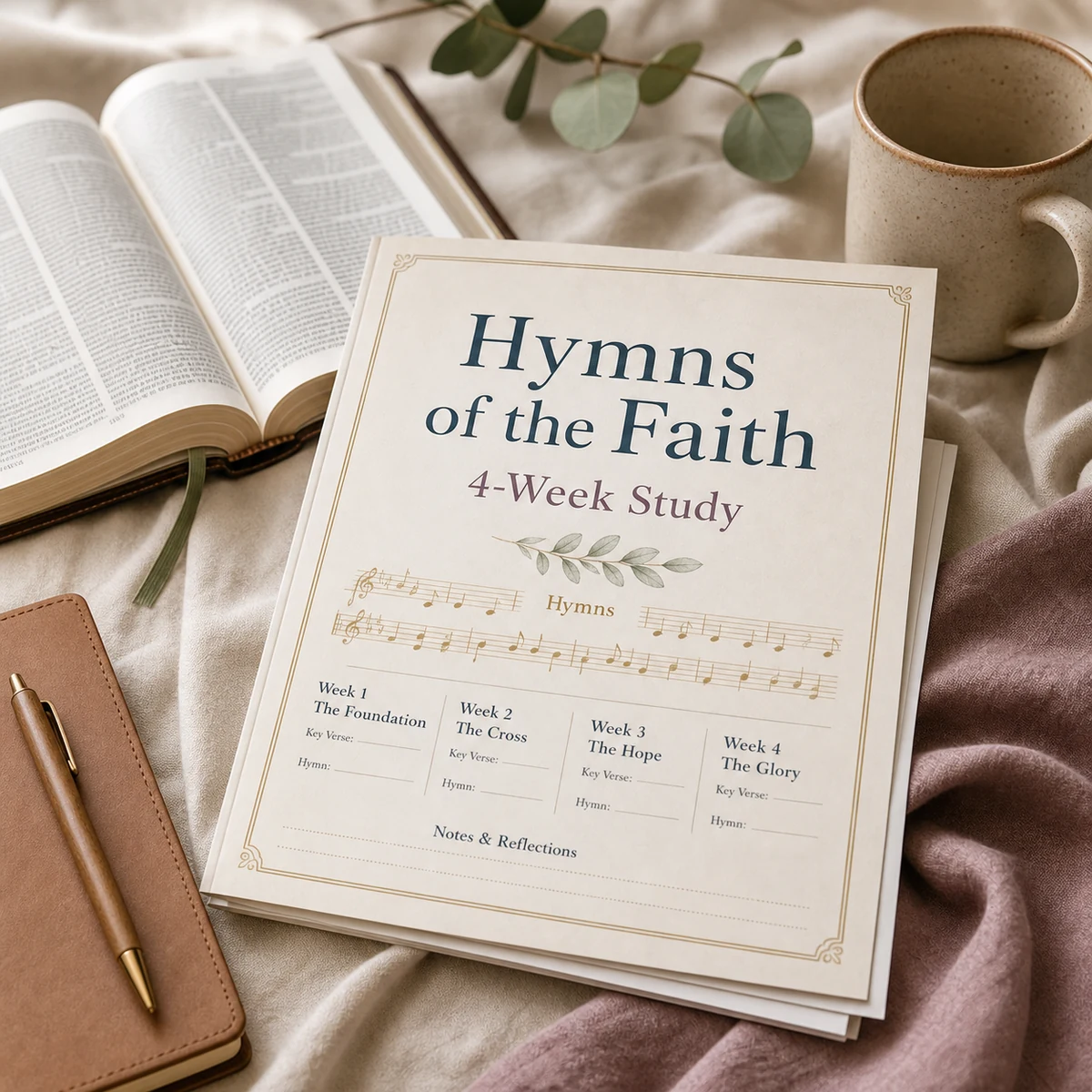
If you would like the history and the Scripture behind well-loved hymns gathered in one place, our Hymns of the Faith study pairs each hymn with its story and the passages beneath its language, with room for handwritten reflections.
You might also enjoy the story behind Amazing Grace or the story behind Come Thou Fount of Every Blessing.
A printable to help
Frequently asked questions
- Who wrote O Come, O Come, Emmanuel?
- No single author wrote it. The Latin hymn grew out of the O Antiphons, medieval prayers sung before Christmas, and appeared in print in Cologne in 1710. John Mason Neale translated it into English in the 1850s, and Thomas Helmore arranged the plainchant melody we sing today.
- What are the O Antiphons?
- They are seven short prayers sung at evening prayer from December 17 to 23. Each begins with 'O' and names Christ with a title from the prophets: Wisdom, Lord, Root of Jesse, Key of David, Dayspring, King of the Nations and Emmanuel.
- What does Emmanuel mean?
- Emmanuel means 'God with us.' Isaiah 7:14 promises a child with that name, and Matthew 1:23 says Jesus fulfills it.
- Is O Come, O Come, Emmanuel in the public domain?
- Yes. The Latin text, Neale's nineteenth-century English translation and the traditional plainchant tune are all in the public domain and free to print, copy and sing. A modern arrangement can still be protected, so check the specific setting you use.
- hymn history
- o come o come emmanuel
- advent
- o antiphons
- devotional
Related reading
- The Story Behind 'Come, Thou Long Expected Jesus'The story behind Come, Thou Long Expected Jesus: Charles Wesley's Advent prayer, the Scripture behind its words and the two tunes it is sung to.
- Public-Domain Christmas Hymns: Six Favorites and the Stories Behind ThemSix public-domain Christmas hymns with who wrote them, when, and the Bible passage each one sings from, for families and women's Bible study groups.
- Advent Bible Study for Women's Groups: Questions for Four WeeksAn Advent Bible study for women's groups: four weeks of passages and discussion questions on hope, peace, joy and love, with tips for leading in a busy December.