
November 13, 2026 · 7-min read
Advent Bible Study for Women's Groups: Questions for Four Weeks
Four weeks, four passages and a handful of honest questions to help your group wait well before Christmas.

A good Advent Bible study for women's groups takes four weeks and follows one theme a week: hope, peace, joy and love. Each week you read one main passage together, ask a few honest questions, and close with prayer. This guide gives you a passage and discussion questions for every week, plus simple ways to lead when December is already full.
Advent is the season of waiting before Christmas. In 2026 it begins on Sunday, November 29, which gives groups four meetings before Christmas Day. A calm, unhurried hour together can be the one quiet place in a loud month.
How do I set up a four-week Advent study?
Keep the shape the same every week so the women know what to expect and you spend your energy on the conversation, not the planning.
- Open with a short prayer and, if you like, one verse of a hymn.
- Read the week's passage aloud, slowly. Ask a different woman to read each section.
- Ask one observation question (what does the text say?) and one or two application questions (what does it mean for us?).
- Light a candle, or simply pause in silence for a minute.
- Close by letting each woman name one phrase she will carry into the week.
If you would like more help drawing out quieter voices, how to lead a small-group discussion people open up in has wording you can borrow, and how to start a women's Bible study group covers the basics if this is a new group.
What questions work for week 1: hope?
Passage: Isaiah 9:2-7.
"The people that walked in darkness have seen a great light: they that dwell in the land of the shadow of death, upon them hath the light shined." (Isaiah 9:2, KJV)
Isaiah spoke to people who had known real darkness: war, exile and fear. The hope he offers is a Person, not a mood.
- Who is Isaiah speaking to, and what darkness are they in?
- Verse 6 gives four names for the promised child. Which name speaks to you most this year?
- Hope in Scripture is confident waiting, not wishful thinking. Where do you find it easy to wait with confidence, and where is it hard?
- What would it look like for your group to bring a little light to someone sitting in a dark season?
What questions work for week 2: peace?
Passages: Isaiah 11:1-10 and Luke 2:8-14.
Isaiah describes a shoot from the stump of Jesse and a kingdom where the wolf lives with the lamb. Luke tells us the angels sang of peace on the night the promised child was born.
- What picture of peace does Isaiah 11 paint? What surprises you in it?
- The shepherds were afraid when the angel appeared. What does the angel say first, and why might that matter?
- The angels announce "peace" to people on earth. How is that peace different from a calm schedule?
- Where do you most need peace in this season, and what would it mean to receive it as a gift rather than something to achieve?
What questions work for week 3: joy?
Passage: Luke 1:39-56.
"And Mary said, My soul doth magnify the Lord, and my spirit hath rejoiced in God my Saviour." (Luke 1:46-47, KJV)
Mary visits her relative Elizabeth, and both women rejoice over what God is doing. Mary's song, the Magnificat, is full of Scripture and full of joy that does not depend on easy circumstances.
- What do Elizabeth and Mary celebrate together? Who is there to rejoice with you?
- Mary's song echoes Hannah's prayer and the Psalms. What does it tell us about how Mary knew Scripture?
- Joy here sits beside uncertainty: Mary's future is far from clear. How can joy and difficulty exist together?
- Name one thing God has done that you could "magnify" this week, out loud.
This is a good week to learn about the O Antiphons, the ancient Advent prayers behind the hymn, in the story behind "O Come, O Come, Emmanuel".
What questions work for week 4: love?
Passage: 1 John 4:9-12.
"In this was manifested the love of God toward us, because that God sent his only begotten Son into the world, that we might live through him." (1 John 4:9, KJV)
The final week turns from the promise to the reason. God sent his Son, and John says that love is where everything begins.
- John says God's love was "manifested" in sending his Son. What does it show us about the kind of love it is?
- The love in this passage starts with God, not with us. How does that change how you hear the word "love" at Christmas?
- Verse 11 says that if God so loved us, we ought also to love one another. Who is one person your group could love in a practical way before Christmas?
- If you could sum up what Advent has shown you in one sentence, what would it be?
How do I fit an Advent study into a busy December?
Keep it small. The women in your group are already carrying school concerts, family travel and extra cooking.
- Send the passage early. A short message on Sunday lets everyone read ahead if they wish.
- Ask fewer questions. Two good questions beat six rushed ones.
- Sing one hymn. Our list of the best public-domain hymns for Advent gives you a short story to share and a hymn to sing, so the singing teaches as well as warms.
- Protect the silence. Leave a minute after the last question before anyone speaks.
- Share the work. Let a different woman light the candle or read each week.
Is there a ready-made Advent study for women?
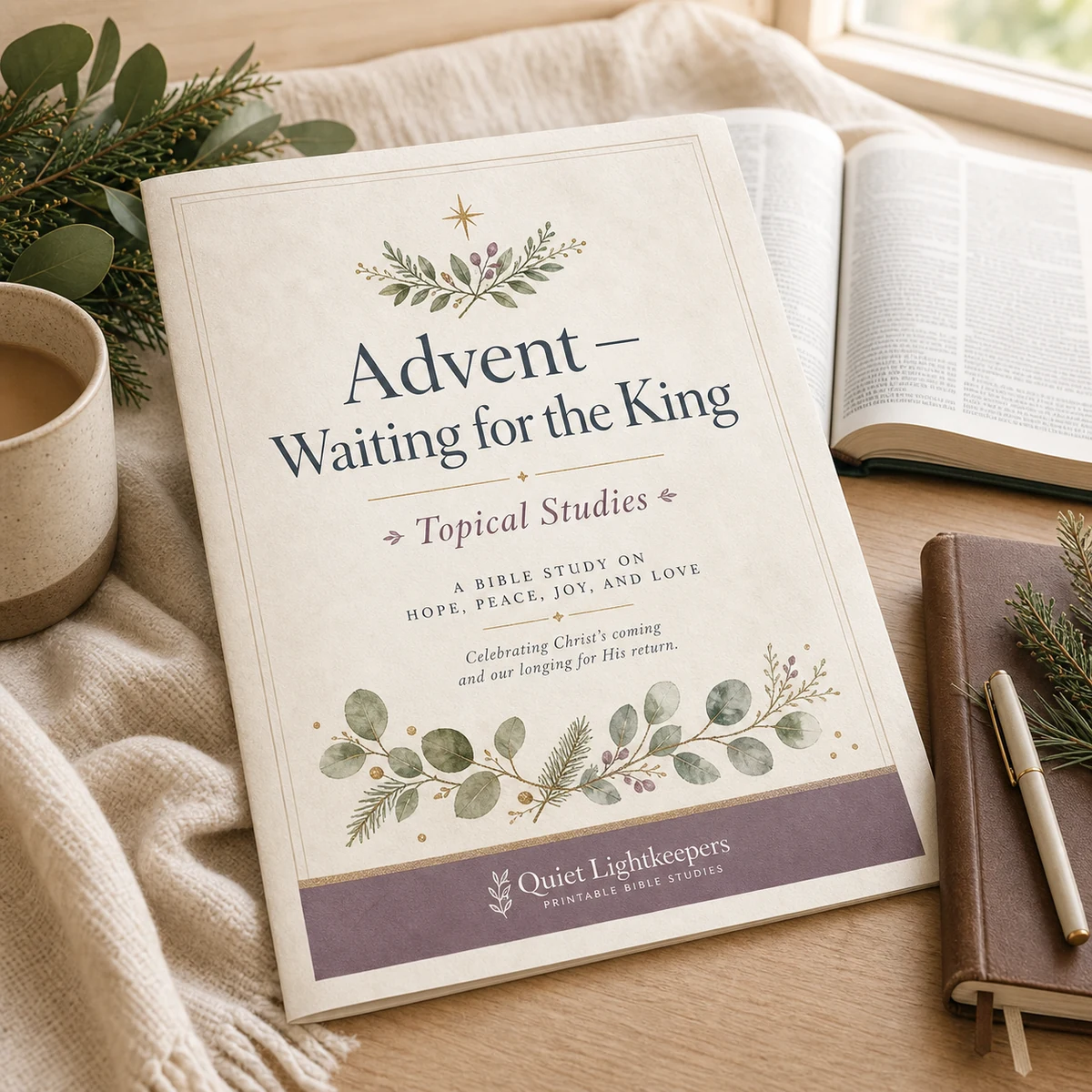
If you would rather not build the sessions yourself, Advent: Waiting for the King is a four-week Advent study for women built on the themes of hope, peace, joy and love. It includes discussion questions for groups and quiet reflection prompts for personal use. If your group is walking through a hard season of waiting beyond Christmas, Trusting God in Waiting Seasons may suit the new year. You can also browse the Quiet Light Keepers shop for other studies.
However you mark the weeks, the aim is the same: to slow down and let the old promise be heard again. An hour a week, with a candle, a passage and a few honest questions, is enough to wait well.
A printable to help
Frequently asked questions
- How do I lead an Advent Bible study for a women's group?
- Meet once a week for the four weeks of Advent and give each week one theme (hope, peace, joy and love) and one main passage. Read the passage aloud, ask an observation question and an application question, and close with a short prayer. Sixty minutes is enough.
- What Bible passages work for an Advent study?
- Isaiah 9:2-7 for hope, Isaiah 11:1-10 with Luke 2:8-14 for peace, Luke 1:39-56 for joy, and 1 John 4:9-12 for love make a simple four-week path. They move from the promise of a coming King to the birth itself.
- How long should each Advent session be?
- Forty-five to sixty minutes works for most groups in December. If your women are stretched thin, shorten the discussion to two questions and keep the reading and the prayer.
- What if our group can only meet two or three times before Christmas?
- Combine the weeks. Hope and peace can share one meeting around Isaiah 9 and 11, and joy and love can share another around Luke 1 and 1 John 4. Ask fewer questions rather than skipping the passage.
- Can we use hymns in an Advent women's study?
- Yes. A single public-domain hymn at the start or end of each meeting, such as 'O Come, O Come, Emmanuel' or 'Come, Thou Long Expected Jesus,' ties the study to the season without adding preparation.
- advent
- advent bible study
- womens bible study
- small group leaders
- christmas
- seasonal
Related reading
- The Story Behind 'Come, Thou Long Expected Jesus'The story behind Come, Thou Long Expected Jesus: Charles Wesley's Advent prayer, the Scripture behind its words and the two tunes it is sung to.
- Public-Domain Christmas Hymns: Six Favorites and the Stories Behind ThemSix public-domain Christmas hymns with who wrote them, when, and the Bible passage each one sings from, for families and women's Bible study groups.
- The Story Behind 'O Come, O Come, Emmanuel'The story behind O Come, O Come, Emmanuel: seven ancient Advent prayers, a Latin hymn and Neale's English words. Here is its history and what each verse means.